Getting Christmas right

Peace on earth and goodwill to all men….

Not always true at Christmas! Close proximity to relatives, too much food and over-excited children can be a recipe for disaster in any family. Then you add into the mix a child with special educational needs, and BOOM!

But, this year Hubby and I are quietly congratulating ourselves on getting it right.
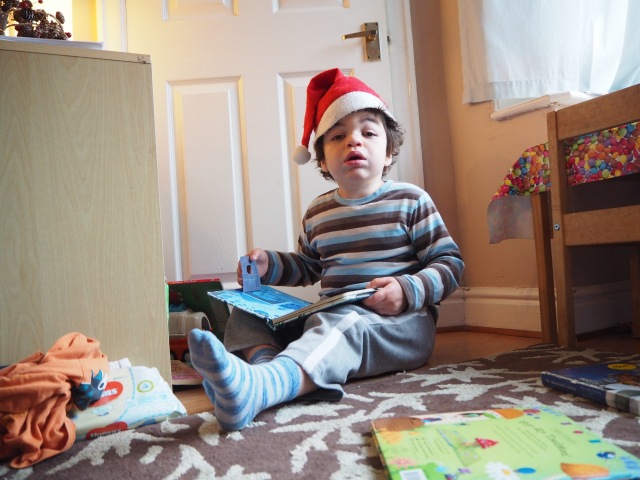
Pudding wearing a Christmas hat surrounded by books.

In the run-up to Christmas my Facebook and Twitter feeds were full of other SEND parents dealing with anxious or autistic children finding it hard to deal with the change in routine. Most children love the release from lessons for nativity plays, Christmas crafts and so on, but for some it is an incredibly difficult time. Thankfully, this is not an issue for us – all the excitement just passes Pudding by. When other adults ask ‘Is he looking forward to Christmas?’ the simple answer is  – he doesn’t have a clue. I recently wrote about him being cognitively around the level of a two year old. But how many two year olds don’t understand about Santa and presents?

I’m glad that we could still enjoy all the Christmas preparations with T (any reservations he had about Santa’s existence disappeared when December came!), but this year I let go of the need to include Pudding. It’s not fair to ask him to help put out mince pies for Santa when he’ll just want to eat them himself.

It’s not worth buying him lots of presents when he still hasn’t played with many that he got last year.

There’s no point wrapping presents when he doesn’t want to open any. (Endearingly, he looked so happy when given a wrapped parcel, and did wave it around happily showing everyone, but then wandered off.) I just put his things in one big gift bag that he then tried to stuff Hubby’s slippers into as well.

Pudding watching a film on his tabletOn Christmas Day itself, he woke up a bit later than usual so T’s stocking was already open and I was free to get Pudding’s breakfast – definitely more important than presents in his view! Later he did his usual thorough job of pulling all the books off the shelf while we opened our presents. We had a lovely walk in the woods with Sister and family, where he could chase around with his brother and cousins. Then he pretty much watched films on his tablet for the rest of the day while we relaxed*, chatted, played games and drank.

So we might not have given him the perfect picture-book Christmas, but we gave him the perfect Christmas Day for him. And to top it all, at dinner we discovered that he loves roast parsnip – what a day!


(*  Special shout-out to Sister and her partner for sterling work in the kitchen to allow this. I made the vegan main, and the Christmas cake but that was about it.)
Trial Update

So we’ve reached that cliff-edge a little sooner than I thought.

Today, Shire (the pharmaceutical company that is running the trial) released this press release. I’ll give you a moment.

Read it? Confused? I’ll see if I can translate….

Now that all the boys have completed their first year on the drug or in the control group, Shire have looked at the data. Specifically they were looking at those dreaded cognitive assessments and seeing how they differed in the boys receiving the drug and those who weren’t. And these results haven’t shown enough of a difference to take the drug forward for approval.

To be honest, I’m not that surprised. Pudding hates the tests almost more than I do, and for the last two times at least has refused to do tasks that I know he is capable of. Why should he draw a circle for the man when he knows there is a football outside that he could be kicking down the corridor? These old-fashioned cognitive tests simply don’t work well with our MPS children. (And yes, clinicians and parents have already been telling them this.) Also, a year is such a short time to assess change in a long-term progressive disease.

So, the pharmaceutical company is going to now look in greater detail at the results from each individual to see if they can pick out useful trends and data. Many families – particularly those with boys who have been on it for years – can tell them of so many ways in which it is working for them. But I simply don’t know if in the end, that will be enough. In the meantime, Pudding and the other boys already enrolled on the trial will continue to receive their dose as usual.

So, it’s not the worst news, but it’s also certainly not the best. We’re teetering on the edge of that cliff and all we can do is wait. And for those families hoping for this treatment to be made more widely available, the wait is even longer.

IMG_8122

(This is my first blog post for a wee while as Hubby has been doing some behind-the-scenes work transferring the website to a new home. Hopefully I haven’t lost anyone in the move. If a few email subscribers could wave to say you’ve got this, that would be great!)

Paperwork and assessments

Paperwork. Every SEND parent’s favourite thing. NOT!

Endless pages of assessments that never really become easier. The joys of having to answer ‘No’ to question after question about everyday skills that any unaffected five-year-old could do with ease.

When Pudding first entered the clinical trial his DQ (development quotient) score was 56 (so 56% of what another child his age would get). That put his abilities at around half his actual age. Two years later I don’t know what it would be now. He’s nearly six and I often describe him as functioning like a two year old, but although that’s true in some respects it is way off in others.

The last few weeks I’ve been filling in information for the Imagine ID project. This large-scale study aims to collect data from families on how genetic conditions affect development in children. I’m not complaining really, because it is something I have chosen to do – research is important. But I must admit it doesn’t always put me in the best of moods having to face up to the realities of Pudding’s abilities.

Some of it was pretty straight-forward – other questions not so much. For instance, it’s pretty difficult answering a question like ‘Does he blurt out answers in class more or less than other children his age?’ when he is non-verbal! And I’m not quite sure it’s worth getting him to do the ‘fun drawing task’ as it will just be a scribble.

IMG_6601

Anyway, I’ve now had the report through and it confirms (if I didn’t know already!) that he scores high for troublesome behaviour, attention difficulties and sleep.

And then we have also had the review meeting for Pudding’s EHCP (Education and Health Care Plan). This is a document that sets down what a child needs to have put in place to help them succeed at school. It is certainly more positive than some forms (yes, DLA form, I’m looking at you!) as it looks at what he has achieved alongside setting targets for the next year. For instance, this time we were able to put a tick next to ‘Can take his coat off’!

But again, it can be a bit brutal facing reality. The educational psychologist had been in to assess him and I was asked for permission to change the way Pudding is described from ‘moderate learning difficulty’ to ‘severe learning difficulty’. The teachers did apologise when asking this, as they were concerned about how I would feel. Looking at the descriptions though, I know it makes sense. When Pudding was first diagnosed he was at playgroup and his differences weren’t quite so obvious. As time goes on, he is progressing but at a far slower rate than his peers, and that gap is widening and widening. So that’s another label he’s acquired.

And on Tuesday it’s our next trip to Manchester with …guess what… the psychological assessments again!

But of course, none of these assessments will ever truly give a picture of Pudding is like. They can tell someone that he is non-verbal, prone to violent outbursts or that his DQ is hitting new depths. But they can’t tell anyone how gorgeous his smile is. Or how he does a funny little dance when he’s excited. Or how much we love him.

Which is why I’m getting better at looking past those forms and reports. And instead I keep in my mind pictures and memories like this morning when T went upstairs to get Pudding up. I watched on the monitor as my big boy sat on his brother’s pillow and gently stroked his head, telling him that he’d put his cereal out ready. I watched him bend down and kiss Pudding and help him turn the duvet down. And I knew that these little moments are what life is really about.

(If you enjoy reading about Pudding and don’t want to miss out on any updates you can subscribe to get new posts direct to your email. Just go to the ‘Subscribe’ section in the right-hand sidebar.)

Cliff-edge

I wrote recently about feeling lucky, and that’s still the case. But of course, life is more complicated than that. The truth is that right now we’re walking on a fairly even path. The sun is shining, we’re having a fun outing as a family and we’re enjoying the view. But somewhere up ahead of us is a cliff-edge.

We don’t know when we’re going to get to it, though we know it’s close. We can’t change direction to avoid it. We have no choice but to keep on walking forward and just hope that we don’t fall headlong down into the chasm below.

Sorry, that analogy went on longer than I expected. Yes, I’m talking about Pudding’s clinical trial.

I think it’s getting pretty clear to anyone who knows Pudding that he is still gaining skills, whereas boys with Hunter Syndrome really shouldn’t be at this age. Yesterday I watched a video from school of him taking part in a relay race. I just couldn’t believe that it was my little boy running to a classmate, handing over the beanbag and then waiting patiently for his next turn. Yes, of course he still needed support, but the understanding and concentration he was demonstrating were… Well, we were all amazed and T begged to see it again and again. So, from our point of view, the trial that is putting enzyme into Pudding’s brain has to be making a difference.

But what is the cliff-edge?

Around this time in 2016, the final boys were recruited onto the clinical trial which officially runs for one year. (Pudding is currently on the extension study where he still gets the enzyme, but we don’t have quite as much testing.) The pharmaceutical company will therefore have all the data they need to look at the numbers and see whether it is a treatment option that is worth pursuing.

At that point they could just decide to cut and run. That is the first stumbling block but I don’t actually think it’s likely. Some boys have been on this intrathecal enzyme for years now, and are continuing to gain skills. Some trials (including for MPSIII drugs) get pulled part-way through the clinical period due to interim results. But that has not happened with this one which makes me think that the figures so far are promising enough.

The next step is for the drugs company to apply to the FDA and EMA (the bodies overseeing medicines in USA and Europe) for approval. This is a complicated process, could take months and even if the drugs company think they have good evidence, could still result in a ‘no’.

And then, and then…. the NHS would have to decide whether to fund the treatment. That’s the one I’m most scared about.

As ever, it’s the not-knowing that I find hardest to deal with. Not knowing how long we have to wait until we find out. Not knowing what the answers will be. The analysing and second-guessing can drive you crazy.

I don’t think I can deal with thinking about it much. So I’m doing what I can to stay relatively sane. Until we reach that cliff-edge and are teetering on the brink I’m going to keep on walking, ignore the inevitable and enjoy the day while we can.

And I will continue to remind myself that we are indeed still lucky. Other families are much nearer that cliff-edge than us. While decisions are being made, Pudding’s treatments will probably continue to be offered by the pharmaceutical company. Boys who didn’t make it onto the trial still have nothing.

Old Age

I often feel old these days.

Let’s face it, I’ve always been a bit of an old fuddy-duddy, but lately it seems to be catching up with me physically. I’m not as flexible as I used to be. Hubby laughs at me when I get up off the sofa and have to hobble for a few paces before I can straighten up fully.

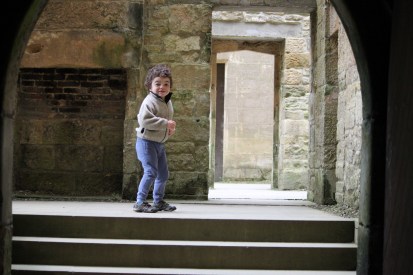
Pudding looking back at the camera whilst he heads out of a ruined castle archwayI can still race after Pudding when I need to. Other parents will attest to that after seeing me go from 0-60 in two seconds when he’s about to head out the playground gate. But some days it’s an effort.

I turned 40 while I was pregnant with Pudding, and do wonder if I’d find it easier in a younger body. Lack of sleep really does me in – even nights when I’m only vaguely aware of him chatting can leave me exhausted the next day. And bruises I get from him last for weeks.

You might think that with age comes more experience, conferring an advantage in the particular battles involved in raising a child with special needs. But I’m privileged to know a number of younger MPS mums who are doing a bloody marvellous job at just that (waves hello – you know who you are!).

Of course I’ve often wondered if my age is actually the reason for Pudding having MPS. Hunter Syndrome is the only x-linked version of MPS. This means it is passed down on the ‘x’ chromosone from the mother only. I don’t have the gene deletion on my own DNA so Pudding’s case is from a spontaneous mutuation.

Of course I was aware as my single, non-childbearing years continued to pass that my fertility was declining. The ‘cliff-edge’ diagrams and comments about ‘selfish women wanting to delay children due to their careers’ are thrown at you by the media. The link between older mothers and increased likelihood of having a child with Downs Syndrome is well documented and I was prepared for that outcome when I was pregnant. But I’ve never actually dared to ask the question about a similar link in MPS – whether a spontaneous mutation is more likely as the mother’s age increases. I don’t think I really want to know the answer. It’s done now. I can’t change what’s happened. I always expected to have children much earlier but never met the right man until Hubby.

My worry now is for the future. As we age, what will happen to Pudding? Who will care for him and see that he is well looked after? With new treatments becoming available maybe he will beat the odds and kick MPS in the butt. But if he makes it to 30 years old, I’ll be 70. Current attitudes to disability and long-term care available in this country don’t exactly fill me with optimism.

Sometimes the thought of losing him earlier is less scary.

Lucky

Well, what a hectic half-term that was. We headed to the wilds of a Yorkshire forest for 4 nights with my parents, Sister and family. Then it was back home for Pudding’s ERT, straight off to Leicester, via Martin House, and back just in time to drop both boys off at school yesterday morning! Hubby and I were both fairly sleep deprived and loved having our own bed  last night, but the week has helped me realise again how lucky we are.

Yes, I know how strange that might sound to some people. And I certainly couldn’t have imagined saying it two years ago when we first got Pudding’s diagnosis, but lucky we are.

Pudding in red waterproofs running away along a forest path.

The Forest Holiday (which could have been a disaster if I hadn’t realised we’d booked for a completely different site to Sister) was a superb family break. Having other adults around to help supervise Pudding takes the pressure off us, and Pudding always laps up the extra attention. Although we wouldn’t let him try the zipwire, pumpkin carving or outdoor hot-tub, he did come on some beautiful walks in the November sunshine and there was always the TV. I am so grateful that I have family living nearby who also don’t mind sharing their holidays with us.

I wrote about Martin House on our first wonderfully relaxing visit. This time was a bit different as we decided to leave Pudding there after our first night, and head off for a trip to the National Space Centre. It meant that T had undivided parental attention for 30 hours which he certainly appreciated. I also noticed how much more we could enjoy him without having to negotiate the sometimes difficult interactions between the boys. And although I thought about Pudding often and worried about things like bedtimes, I had complete confidence that he would be very well looked after. Yet again, I felt lucky that we have access to this resource.

We have a stable family life, a roof over our heads and enough money to live comfortably. We are lucky to have one gorgeous son with no medical issues and despite his MPS, Pudding thankfully has very little in the way of day-to-day health needs.

During the time that we were at Martin House, we did of course see children who are far more poorly than Pudding. It’s a hospice after all. But despite this, it is not a sad place. And in fact, talking to other parents and seeing the matter-of-fact dealings of suction tubes and peg feeds is sort of reassuring. It helps me think I could deal with that if I need to.

Unlike many families we haven’t had to fight. So many others – not just those with MPS – struggle to get diagnosis, struggle for access to services, have to fight for school provision, fight for EHCPs, DLA and Blue Badges (see glossary). Although the forms and medical stuff still take it out of me, I feel lucky that our path is easier than some.

Of course, it isn’t always easy to focus on the positives. But I know things could be so much worse for us, so right now I’m living in Luckyville.

Halloween

Tis the season of spooks and sickness bugs, nights drawing in and Halloween.

Hubby is still recovering from the bug that Pudding and I both had so he wasn’t up to coming out with us. It was glorious weather yesterday but sometimes I find it downright scary to take both the boys out by myself. I gritted my teeth and headed off to Lotherton Hall. They always go all out for Halloween there and T was really keen to do the spooky scarecrow trail.

I was all geared up for the more terrifying aspects – stares from other children, chasing Pudding when he makes a bid for freedom, struggling to push the buggy over uneven surfaces, the nightmare of finding a suitable place to change his nappy…

After a morning of losing my temper, shouting and generally being a grumpy Mummy from Hell, I was NOT looking forward to it.

But…

It all went rather well. T was brilliantly helpful pushing the buggy while I chased Pudding, helping me with the lift and generally being patient. We found all the scarecrows. Pudding looked rather fetching in his new hi-vis jacket. I didn’t get any officious persons objecting to us taking the buggy into the house (yes, some people in other places REALLY want to make it difficult). And best of all was the loo!

Normally, I just find a discrete corner out of the way to do a nappy change al fresco – much nicer than lying him down on a toilet floor. But not in this weather. I thought the disabled loo would probably have the best chance of having a large enough, clean enough floor space, so tracked down the key from the cafe.

I opened the door, and was delighted to find a full-sized adult changing bench with hoist above it (not that we need that bit). I simply hadn’t realised that the facilities there were a proper Changing Places toilet – the gold standard for those who can’t use the usual toilet facilities. T didn’t quite share my vocal enthusiasm and chose to wait outside while I changed Pudding in glorious comfort, not having to bend over him on the floor or worry about the hygiene.

Only problem is, I could come to expect this standard, and there simply aren’t enough of them out there….

The necessary

We’re back in Manchester again. Clinical trial dosing day. Sometimes it seems to come round really quickly. And today I really didn’t want to come.

Pudding watching TV in the hospital playroom

There’s a bug doing the rounds at the moment. Pudding had it last week and very kindly passed it onto me. It wiped me out completely on Friday (Hubby said that he knew I was ill as I wasn’t even going on Facebook) and I expected to feel better the next day. But I didn’t. Or the next day. Or Monday. No awful symptoms, just feeling bloated and spacey and draggingly tired.

The thought of setting off on the train and spending a long day in hospital today was about as welcome as…well I’m sure you can think of something. I checked with the ward hoping that they would say not to come, but they didn’t.

A couple of people asked whether I’d be better just staying at home and missing the dose, and oh I was so tempted. But I couldn’t ignore that little voice in my head. The one that reminds me how important this treatment is. The one that whispers how lucky we are. The one that warns we may not have too many other doses left to us if it doesn’t get approved or funded.

So I’m here. And coping.

We do what we have to, don’t we? All parents do. We get out of bed. We make sure they’re clean and fed. We nag them about homework. We stand by the side of a pitch in the rain. We travel across the country. And we hold them down for needles. Our own needs sometimes just have to take second place.

We do what is necessary.

Gym

Many people consider going to the gym as a luxury. Not me.

Anyone who knows me will vouch for the fact that I’m not a natural exerciser. I’m not completely sedentary, but the idea of going for a run (heaven forbid!) makes me shudder. But I joined a gym in January and have defied the odds by actually continuing to go.

Last week, I got a slight cold and the lack of sleep led to my back grumbling. If you’ve ever had back pain before you’ll know how awful it can be. The idea of being crippled by that intense pain again was scary. I wasn’t just thinking about the impact on me, though that was a big issue; I’ve spent months recovering in the past while living on my own, which of course wasn’t much fun.

If I was to suffer pain like that again now, it would affect so much more though. If I was in pain who would push the heavy buggy to and from school? How could I drive Pudding to appointments and hold him still for the needles? How could I run after him in the playground, or wrestle him to the ground for a nappy change?

What happens when a carer is no longer able to care? I know Hubby would have done what he could but he has a full-time job. And what happens to those carers who don’t have anyone else to rely on?

Some trainers and a gym bagPudding weighs over 4 stone now and looking after him is hard physical work sometimes, particularly when I’m only 8.5 stone myself. My only solution is to make sure I’m as fit and strong as possible. Hence the gym. It helps that the place I go to is full of friendly faces and has a pool and classes as well, so it’s not just slogging on the gym floor. (I’m easily bored!)
The gym for me is not a luxury, it’s a physical necessity. And this week I realised that it’s even more than that. My mood took a bit of a nose-dive with the back pain, and even when I started moving better my mood didn’t. Eventually I forced myself out to do an easy work-out on the treadmill, etc, and I felt so much better all round. Yes, I know that exercise releasing happy endorphins is hardly a revelation yet it makes a difference finally realising it for yourself.

I’ll never be a proper gym bunny but I can admit that sometimes I do quite enjoy it! Maybe some day I may even get round to replacing my embarrassingly tatty trainers…

Marriage

Weddings are easy. I’ve never quite understood all the stress about them. We had a lovely little register office ceremony followed by a meal at a local restaurant for good friends and family.

Marriage though, that’s the hard bit. Marriage, and any other long-term committed relationship, can be full of little niggles. ‘Why doesn’t she ever remember to lock the shed?’ ‘Why can’t he hang his towel up properly?’ ‘She talks in her sleep.’ ‘Oh my word, will his snoring ever stop?’

Ours became harder after having kids. Routines get interrupted by small, demanding bodies and lack of sleep isn’t known for improving rational conversation. Relaxed weekend mornings become a thing of the past. And we weren’t the first couple to realise this new life makes a difference. Many parents struggle to find time for each other.

So when you add a disabled child into the mix and all the emotional stress of a life-limiting disorder, it’s little wonder that many marriages break under the strain. Studies have shown that the risk of divorce or separation is higher for those parenting a disabled child.

I think we’ve both got better recently at looking after ourselves. Hubby has taken to meditating and doing brilliantly at it. (Sometime soon I expect I’ll blink and he’ll have turned into a Buddhist monk.) But amidst the self-care we have to remember to think about each other too.

Swinsty-031Yesterday Hubby had a day off work. I was full of cold and very tempted just to go back to bed, but instead I made the effort and we went for a walk. I was so glad we did. The sun was shining and the wind blew away some of my fogginess. We chatted. We listened to the birdsong and laughed at the inescapable smell of cowpats. We took full advantage of the kissing gates. It was even warm enough to eat our lunch outside at the cafe.

Hubby and I have obviously had the occasional meal out or cinema trip once the kids are in bed. But making the time to go out together during the day, felt … more relaxed, more free, more like before having children. A reminder of how important we are to each other.

Recently I wrote a sort of love letter to our doctor, so I guess it’s only fair I write one to you too, Hubby.

I know I find it hard dealing with much of Pudding’s difficult behaviour and appointments myself. But you don’t have an easy life either – working full-time and also having the same emotional strains. I’m glad that we are able to talk things through and I admit that the reason why any relationship niggles don’t last too long is mostly down to you. You are so much better than me at building bridges.

In our marriage vows I promised to be there when you cry and to laugh at your worst jokes. I promised that when we disagree I would do my best to understand you and that when I was hurting I would try to tell you why. I’m not sure I do too well on some of these (you make the jokes one particularly difficult!) but I do think of what I promised quite often. And I do try.

You’re by no means perfect but then neither am I. No matter how grumpy or sulky I get, you should know that I’m glad I’m walking this path with you. I couldn’t have chosen a better husband or father, MPS or no MPS.

Love always, SB xx

For those in the same position looking for more advice and support, Contact (previously Contact a Family) has a great booklet on looking after your relationship while parenting a disabled child.